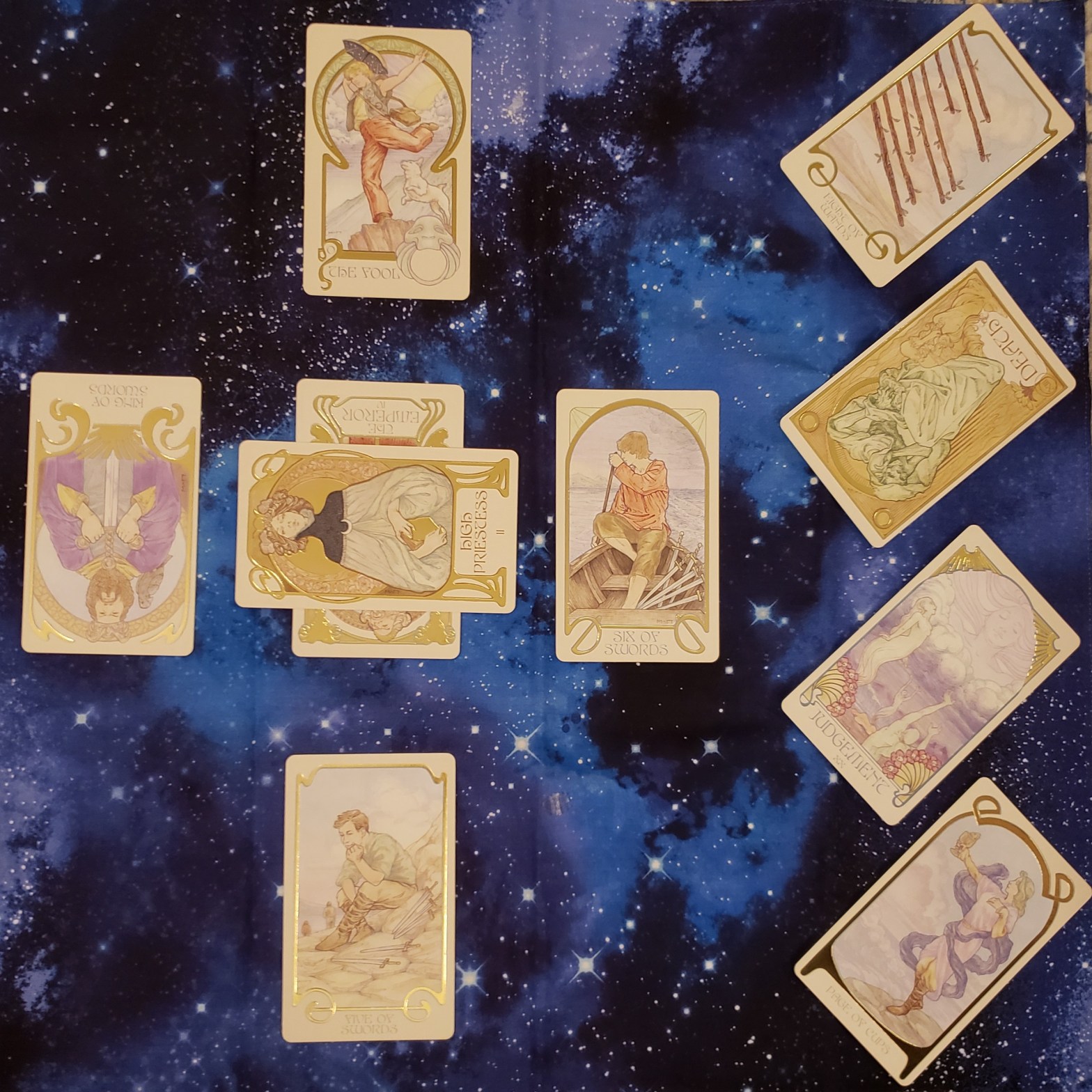
Background
Tarot (pronounced: ‘tarrow’) reading, also called cartomancy, is an ancient form of divination that is still going strong today. It’s origin dates back to the twelfth century, though no exact date is known. There are other forms of cartomancy, such as oracle, leanormand, and playing cards, but tarot is the most popular. The modern day deck of cards is actually originally based off the minor arcana of the tarot deck! Pentacles turned to diamonds, wands to clubs, cups to hearts, and swords to spades.
Generally in tarot, there are 78 cards in the deck, 22 of which are the major arcana and 56 of which are the minor arcana. The minor arcana consists of four suits: wands, cups, swords, and pentacles. Sometimes decks may use coins instead of pentacles or substitute the four suits for the four elements, the four directions, or the four seasons. These substitutions are as follows:

These days, there are hundreds, if not thousands, of different tarot decks. You can find them on a number of websites, metaphysical shops, etc. It’s important to choose a deck that speaks to you. A good starter deck is the Rider Waite Tarot deck. This deck was the first modern tarot deck and is considered the ‘classic’ tarot from which most meanings and designs are based.
Once you obtain your tarot deck, it’s important to cleanse it before use. My preferred method of cleansing is my running the deck through sage smoke until it feels cleansed. If you prefer, you can use any number of cleansing methods. If you leave your deck sitting for a while, make sure you recleanse it before doing a reading.
For storage, some prefer to keep their deck wrapped in silk or placed in a box. I personally leave my decks in the boxes they come in. The choice is yours – there are many websites and metaphysical shops that sell a plethora of options for tarot storage.
When doing your first few readings, try not to take them too seriously. It can take a few tries and some learning before your intuition really starts to kick in.
Reading the Tarot
Once you have picked out and cleansed your deck, you’re ready to begin your tarot journey! Some people go through the deck and choose a ‘significator’ card, or card to represent the person for whom they are reading. I prefer to leave all the cards in the deck, but you should do whatever works best for you.
Start by shuffling the cards. Some people choose to read tarot upright only, but you can also shuffle the deck so that cards are both upright and reversed. Neither method is more correct – do whatever feels right to you. Think of your question or problem and fill the cards with your energy as you shuffle.
Once you feel you have shuffled enough, you’re ready to draw cards. Some people like to cut the deck and draw from there, but you can also just draw straight off the top. Use your intuition and do what feels right.
As you draw, place the cards in their corresponding spots for the spread you’re doing – they will usually be numbered. You can either place them face down and flip them as you read, or you can simply place them face up and read them that way.
When reading tarot, remember that things are not always what they seem. Death seems like a very intimidating card, but it does not always mean someone is going to die. Similarly, The Fool does not necessarily mean stupidity or poor decisions. It’s all about your intuition.
The 78 cards of the tarot have general meanings for their upright and reverse positions. You can read using these meanings or using your intuition. As you start to practice more, your readings will come more naturally.
My favorite source for tarot card meanings is https://www.thetarotguide.com. This website shows very detailed upright and reversed general meanings for all the cards in the deck. It also provides the upright and reversed meanings of each card if used in a love/relationship reading, money/career reading, spirituality reading, or health reading.
There is also a section of the website with flashcards to help you learn the general meanings. Overall, this website is a great resource for both beginners and experienced tarot readers.
During your readings, you may notice patterns arising. If you see many of the same suit showing up, this can be indicative of the general trend or direction of the reading. These trends are as follows:

Another pattern you may notice is the number of upright and reversed cards. In general, upright cards are read in a positive manner and reversed cards are read in a negative manner. This is not always true.
General Card Meanings
Most tarot decks will come with a booklet explaining the symbology and meanings of each card. Not all decks agree on these meanings and not all decks are designed the same. Generally, Rider-Waite based decks will give similar meanings. Shown below are the simple meanings taken from one of my favorite decks, the Ethereal Visions tarot.
Suits

The Major Arcana

Minor Arcana
Wands

Cups

Swords

Pentacles

Basic Tarot Spread

A simple tarot spread you can do is the three card spread shown above. This gives three perspectives on your problem or question: past, present, and future. When doing a tarot spread, place the cards in the order you pick them up. Place the first one in the first position (past), the second one in the second position (present), and the third one in the third position (future).
The past card tells you about what shaped the problem; how you got to this point. The present card tells you where you are now; what is currently happening with your problem. The future card tells you what is ahead; what will happen if you continue on the path you’re on.
*REMEMBER* any reading you do for the future is NOT set in stone. Future readings simply tell you what will happen if you continue on the path you’re on. If you’re not happy with what you’ve read, you can change it!
Next time we’ll talk about some more tarot spreads, so check back soon!
Sources
Buckland, Raymond. Buckland’s Complete Book of Witchcraft. Llewellyn Publications, 1986.
Buckland, Raymond. Wicca for One: the Path of Solitary Witchcraft. Kensington Publishing Corp., 2004.
Cunningham, Scott. Divination for Beginners: Reading the Past, Present & Future. Llewellyn Publications, 2008.
Gray, Eden. The Complete Guide to the Tarot. Random House USA, 1982.
Hughes, Matt. Ethereal Visions Illuminated Tarot Deck. U.S. Games Systems, Inc., 2017.
Lisa. “Tarot Reading: The Tarot Guide: Dublin.” The Tarot Guide, 2015, http://www.thetarotguide.com/.
 Northern Lights Wicca
One thought on “Intro to Tarot”