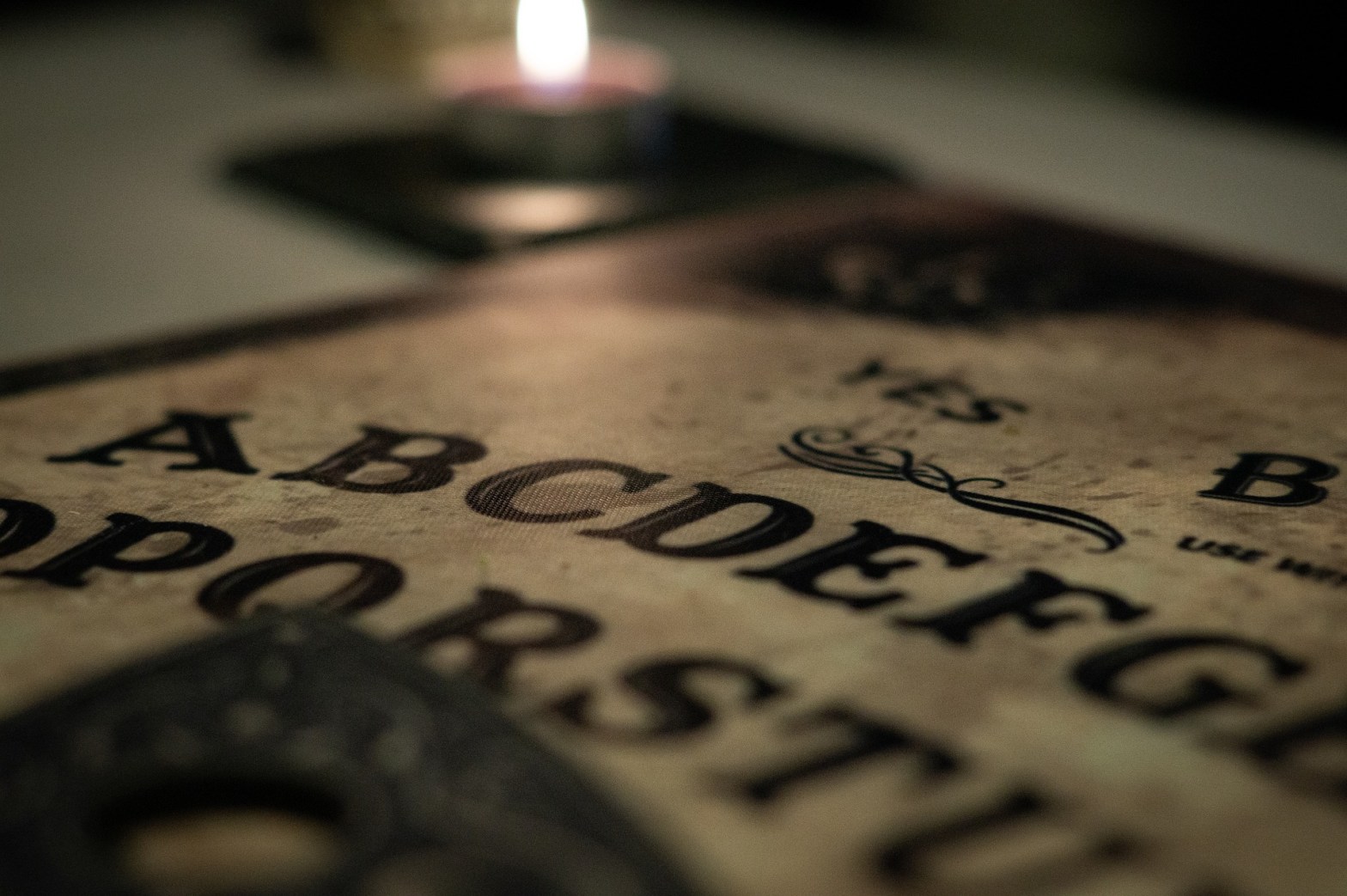
Origins
The modern day Ouija board is a mix of two older methods of scrying. The first is where the letters of the alphabet on the board came from. The wheel of letters of the alphabet was made by laying out small slips of paper with letters on them on a smooth table. An inverted wine glass was placed in the middle. The scryers would sit around the table and place their index fingers on the base of the glass. When they asked questions, the glass would slide of its own volition to spell out the answers. This method was very popular in the 19th century, and perhaps even before that. This is a simple adaptation of the pendulum method of the Romans we talked about last week. The earliest form was the ring/basin pendulum scrying method.
The second method is where the pointer came from. The pointer is the triangular or heart shaped board, slightly smaller than a human hand. It has three legs that elevate it about an inch. This tool was invented in 1853 by French “spiritist” (spiritualist) Planchette (thus, the pointer being called a planchette). He originally invented it as an aid to automatic writing. The planchette had small rollers on the two rear legs and a hole in the tip for a pencil, forming the third leg. A sheet of paper would be placed underneath it and the automatic movements of the operator’s hand would cause the pencil to write.
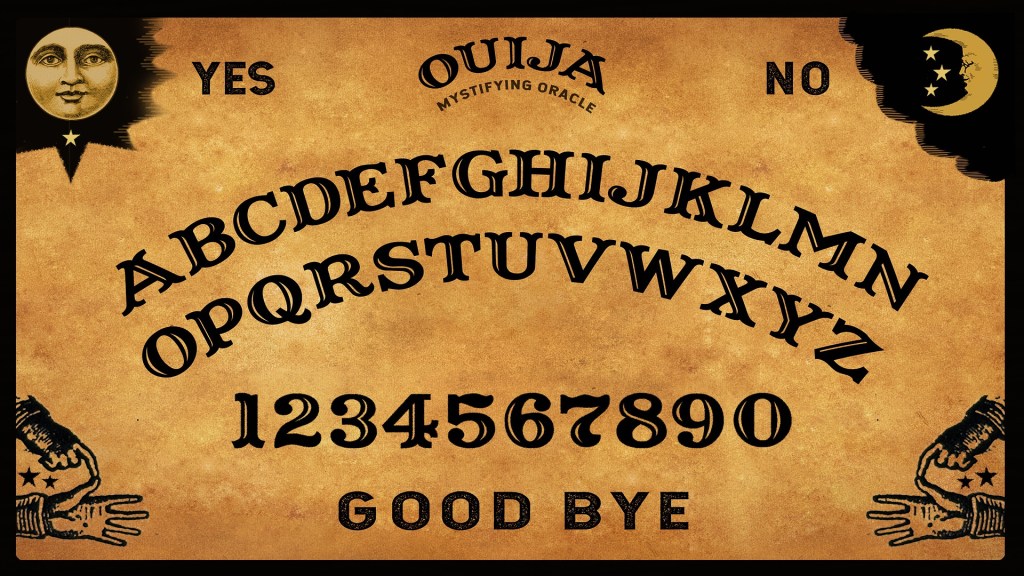
Most people are familiar with the Ouija board, but if you are not, here’s a common modern day Ouija board:
History
The word ‘Ouija’ literally translates to yes-yes; the french ‘oui’ and the german ‘ja.’ The origins of the word are unclear, but Oxford English Dictionary cites 1904 as the first use of the word.
In 1854, Adolphus Theodore Wagner patented the first “talking board” (or psychograph) in England. Then in America in 1891, Elijah J. Bond was granted a patent for the first modern Ouija Board. The patent was purchased the following year by William Fuld who started manufacturing them under the name “Oriole Talking Boards.” His company, Southern Company of Baltimore, was later renamed the Baltimore Talking Board Company.
In 1966, the Parker Brothers bought the rights to the Ouija board and moved production from Baltimore to Salem, Massachusetts. This was right at the dawn of the hippie revolution and the Age of Aquarius, so these boards became very popular, with over two million copies shipped.
The Parker Brothers’ product was very high quality. The board was a heavy pressboard with a highly polished face and the planchette was solid hardwood with removable legs. The legs of the planchette had small felt pads on the bottoms to allow it to slide easily across the board.
Tools
If you can’t find a Ouija board or can’t afford to buy one, you can make a simple one at home! This is similar to the method we discussed in the introduction section. Write the letters of the alphabet on small slips of paper and tape them down firmly in a circle of about 18” diameter. It’s best to choose a smooth surface, like a table, for this. Make sure the circle on the table is in a place that all scryers can reach when seated around it. For a pointer, you can use a small upturned wine goblet.
Alternatively, you can write the alphabet around the perimeter of a square on a large sheet of paper or a piece of smooth cardboard. Write the first seven letters across the top of the square, the next six letters down the right side, the next seven letters across the bottom, and the last six letters up the left side. You may want to include a ‘yes’ on the middle left and a ‘no’ on the middle right; this can speed up responses. Below that, you can write the numbers 1-9. A ‘goodbye’ is not necessary.
Practice
One person alone can use a Ouija board, but they must be an experienced scryer in order to do so. It’s much easier with two or more people. To use a Ouija board, the scryers will sit facing each other, knees nearly touching. They will then place the board on their knees and set the planchette in the middle of the board, point directed at the letters.
The scryers will then place the fingertips of both their hands on the planchette and move it around in a circle for about a minute to loosen their arms. One of the scryers will ask a simple question, preferably a yes/no question, to start. The most common question to start with is “Is anyone there?” After a few minutes of questions, the planchette will start to move easier and be able to spell out answers to more complex questions.
Some people may try to deceive the other scryers in the group by moving the pointer themselves, but trickery like this is easy to spot. When someone in the circle is moving the pointer, it will slow to a stop whenever it lands on a letter and move with slow jerks. The natural movement of the pointer, however, is to slide effortlessly and smoothly, in rapid darts and small circles.
It’s best to come up with a list of questions you plan to ask before beginning. If the board is responsive, you can ask as many spontaneous follow up questions as you need to clarify. It can be very helpful to record the session so you can review it later. This can either be a third party or a tape recorder.
If you choose to use a third party, they will not scry with everyone else, but will be sitting outside the circle recording the answers. Words can be hard to pick out of gibberish if things aren’t written down. It can also be helpful to review the words, since they may be misspelled. The scryer sitting at the base of the board with the best view of the letters and numbers should call out the answers as they are indicated.
The quality of the responses you receive depends heavily on your attitude; if you approach this method seriously, seeking answers to important questions, you will receive serious answers. Responses may not always be accurate in a physical sense. Spirits often have difficulty understanding things in a physical sense and will give their best answers. They will answer you with spiritual truth.
Method
The method for Ouija board scrying is different than the others we’ve talked about. Since more people are involved, things are a little more in depth.
To begin, darken the room and light with only a single, small light source such as a candle. It is common to burn incense to cleanse the space. Sometimes, a glass of water is placed on the table to give the spirits energy.
All the scryers sit in a circle around the board. Cast your circle, say a protective prayer, and invoke your deities. Everyone places their fingers on the pointer. One of the scryers will ask if there is anyone who wishes to communicate. You will either hear a knock or see the pointer move. Start asking questions and recording the answers.
Once you are finished scrying, move the pointer to ‘goodbye’ and say some words to encourage the spirits to return to where they came from. Close your circle, thank your deities, and say a closing prayer. Extinguish your candle and incense and return your scrying materials to storage.
Occasionally, spirits will remain even after the session is over. If you notice this happening, take your Ouija board back out. Acknowledge the spirit; let them know you know they are there and say you’re sorry they have failed to return home. Tell the spirit to go toward the light and meet their guide. Tell them love is the light and they must depart from this plane immediately. Close the session again and say the spirit’s job is finished and their presence is no longer required.
Next week we’ll talk about another method of scrying – nature scrying! So check back soon!
Sources
Robbins, Shawn, and Leanna Greenaway. Wiccapedia. New York, NY, U.S.A: Sterling Ethos, 2014. Print.
Tyson, Donald. Scrying for Beginners. Woodbury, Minn., U.S.A: Llewellyn Publications, 1997. Print.
 Northern Lights Wicca