Introduction
Pendulum scrying is a method that dates back to the ancient Romans. The pendulum can be used for both scrying and divination, but today we’ll be talking about scrying. Since the pendulum is held in someone’s hand, it allows the mind to communicate information through muscle movements and is therefore not random. You are communicating information from your unconscious mind to your conscious mind through senses, so it is scrying.
History
In ancient Rome, this scrying was done by tying a ring to one end of a piece of thread and a wand to the other. The ring was then held over a bowl so it could bounce around off the edge. This movement would then be interpreted as answers to the questions asked.
The bowl is thought to have been made of electrum, a naturally occurring alloy made up of about ⅕ silver and ⅘ gold. The 24 letters of the greek alphabet were probably engraved into the flange of the basin. This flange would have been a broad, flat rim extending out from the sides of the basin. These sides would have risen either vertically or slightly curved inward so that the ring could strike them. The basin may or may not have been filled with water.
The wand was made of vervain, most likely still having green leaves on it. A long thread would have been tied to one of the wand, with a ring hanging from the other end so that it could swing freely within the rim of the basin and continue to bounce off the sides. The ring was probably a simple band made of electrum. Perhaps with characters engraved on it, spelling out the name of a deity. It would have also been heavy enough to bounce easily around the edges of the bowl.
The scrying table had three legs and was made up of laurel branches. It may or may not have had a flat top, but either way it supported the scrying basin. The scryer had a “turban-like tuft of hair” on his head, which was probably a braid or a narrow strip of animal hair or fur wound around the head. He would have also dressed in linen.
Modern Methods:
Ring and Glass Method:
This is one of the older methods of pendulum scrying and is similar to the method used by the ancient Romans. It continued to be used for centuries in Europe. This method involves tying a ring to the end of a piece of silk thread. This thread is then held in a water goblet or glass tumbler. Some say filling the glass halfway with moon charged water may make the pendulum more responsive. This is optional.
The scryer sits at a table with the elbow of their scrying hand resting on the table. (There is debate over which hand this should be. Some sources say your dominant hand, others say your non-dominant hand. As with everything else, you must do what feels right to you).
The scryer then holds the loose end of the thread with their scrying hand and asks their questions. These questions don’t need to be asked out loud, simply thinking them will do. The responses come in the form of tapping sounds as the ring bounces against the sides of the glass. Generally, one tap means yes, two taps means no, and a series of taps means unsure or no answer.
Ring and Cross Method:
This method uses the same posture and the same ring and thread, but uses a sheet of paper in place of a glass. The sheet of paper will have a large + symbol on it. The scryer suspends the ring over the intersection of the two lines and asks their question. Again, you don’t need to ask your questions out loud, simply thinking them will do. Some say if you place a bowl of moon charged water beneath the paper, it will make the pendulum more responsive. This is optional.
There are many ways to read these responses. 1) if the pendulum swings back and forth along the vertical line the answer is yes and if the pendulum swings side to side along the horizontal line the answer is no; 2) if the pendulum swings clockwise the answer is yes and if the pendulum swings counterclockwise the answer is no; 3) if the pendulum swings clockwise or counterclockwise the answer is yes and if the pendulum swings back and forth the answer is no.
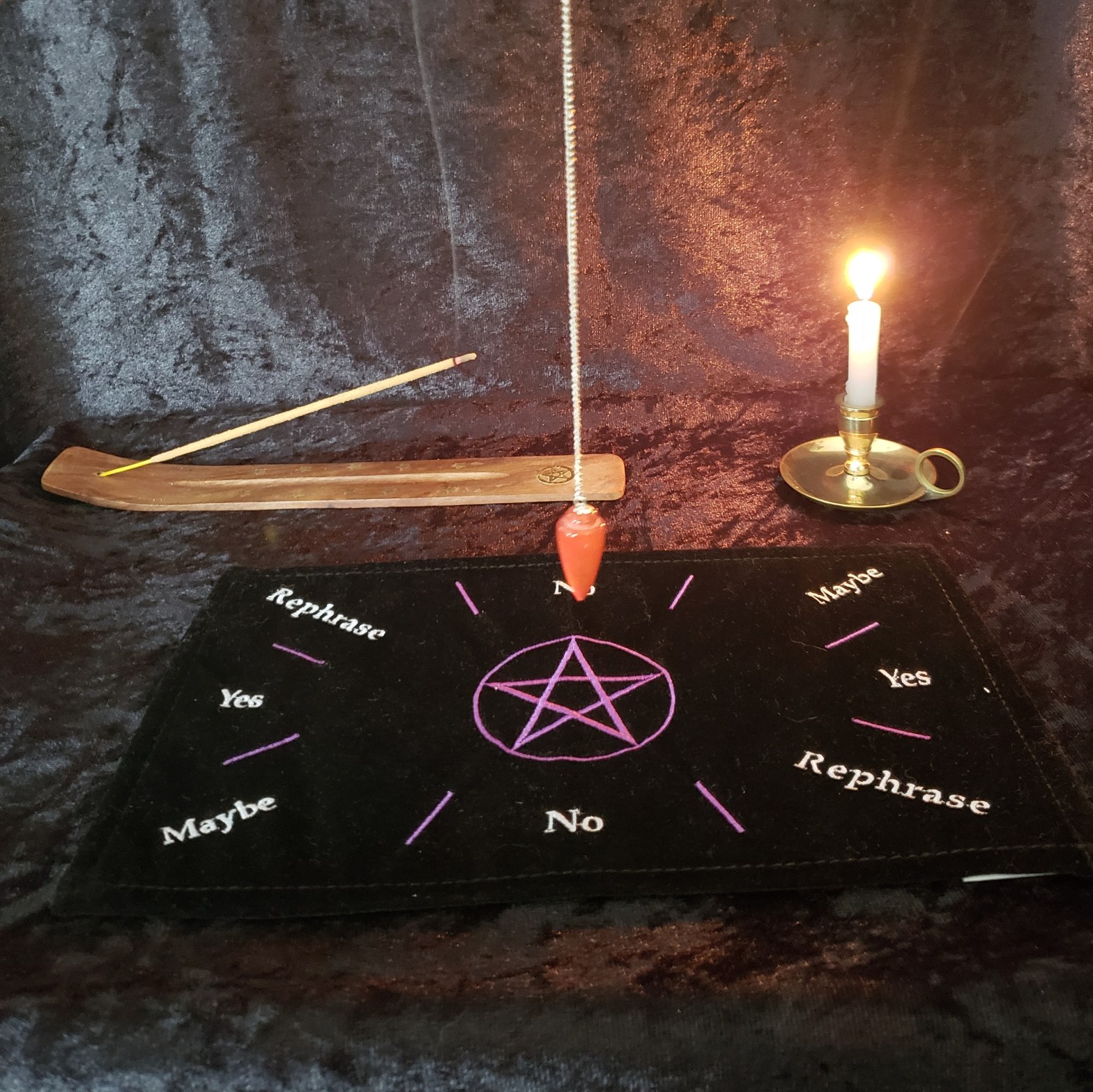
The easiest ways to determine which way you should read the answers are to decide beforehand which you want to use, use a pendulum board/mat with ‘yes’ and ‘no’ lines labeled, or ask simple questions you know the answers to (i.e. is my shirt blue? / is my hair red? / is it saturday? / etc) and see which way the pendulum moves for each answer. You can also just say “show me yes” and “show me no” to determine how the answers will look.
Pendulums
Pendulums can be made out of pretty much anything. Some say it should be a natural object, but you can use wood, metal, plastic, or whatever else you like. Your pendulum can be something as simple as a coin tied with a shoelace! What’s important is that you put your energy and your intention into it.
In terms of weight, some say you don’t want a large, heavy pendulum – one about the same weight as a penny will do. Others say the weight doesn’t really matter. It’s recommended to start with a medium weight pendulum so you can get used to it and practice.
One interesting type of pendulum you can make is a water pendulum. Fill a small vial or bottle with charged water. This water can be from a sacred well, pool, spring, river, lake, etc. or it can simply be water charged by the moon. The bottle must hang straight down on the thread – it won’t work properly if it’s crooked. Glue a ring onto the center of the cap or the center of the underside of the bottle and tie a thread to that.
The most common type of pendulum is a crystal pendulum. If you choose a crystal, it should have at least a slight taper to it. It is suggested to choose a stone about the size of the last two joints of your pinky finger. Quality is a key factor here as well. Attach a small copper, brass, or silver loop of wire to the larger end of the crystal with glue or epoxy.
Tie a piece of fine thread to the loop and trim off the excess. Some recommend silk thread, some say it must be natural fiber, but any thread is fine – even a fine chain made of gold, silver, brass, or copper works well. It is not recommended that you use aluminum, however, as the electrical process used in manufacturing can disrupt your auric field. The chain or thread should be between six and nine inches long, whatever feels right to you.
Most metaphysical shops will sell various types of pendulums so if you can’t make one, check out what your local shops have to offer!
Care and Keeping of your Pendulum:
It is important to purify your pendulum before using it, that way you can clear all the energies and contaminants in it. To start, fill a bowl with fresh, pure water. Hold the pendulum by the end of the thread over the bowl. Say a cleansing prayer of your choice. Here’s one example:
Earth Mother, Queen of Heaven,
Nameless Goddess of many names,
Persephone beneath the stones,
Artemis amid the groves,
Selene among the stars,
Wash from me my doubts and fears,
Purge me from my daily cares,
Cleanse my heart against my foes,
Bathe me in thy celestial dew,
Make bright the mirror of my soul.
As you say this prayer, fill the pendulum with your energy; charge it. Dip your pendulum into the water in the bowl and let it sit for several minutes. Visualize all contaminants and previous energies leaving it and flowing out into the water. Remove the pendulum by the end of the thread and visualize it shining with a white light. Place it on a clean towel and pour the water down the drain.
If there is a different way you would like to purify your pendulum, you don’t have to follow this method. Many different denominations of Wicca have different ways of purifying their tools before use. You may wish to consecrate your tool in a ritual. However you do it isn’t as important as filling it with your energy and intention.
Regularly cleansing your pendulum is important, especially if you use it often. This should be done monthly. There are many ways to cleanse your pendulum. One method is charging via moonlight. On the night of the full moon, set your pendulum where the moonlight will hit it for several hours. To increase the effectiveness of this method, you can place the pendulum in a bowl of clean water with a pinch of salt.
Another way to cleanse your pendulum is by using the elements. For earth: bury your pendulum in the earth (dirt, sand, salt, etc.) and let it sit for a few hours. For fire: place your pendulum in direct sunlight early in the morning and let it sit there until sundown. For water: place your pendulum in a glass of charged water and let it sit for several hours. (You can use moon water for this or charge water by letting a piece of clear quartz sit in it for 12 hours). For air: light sandalwood incense and pass the pendulum through the smoke three times. It can help to say a cleansing prayer or state your intent. (Nag Champa incense is very popular and contains sandalwood).
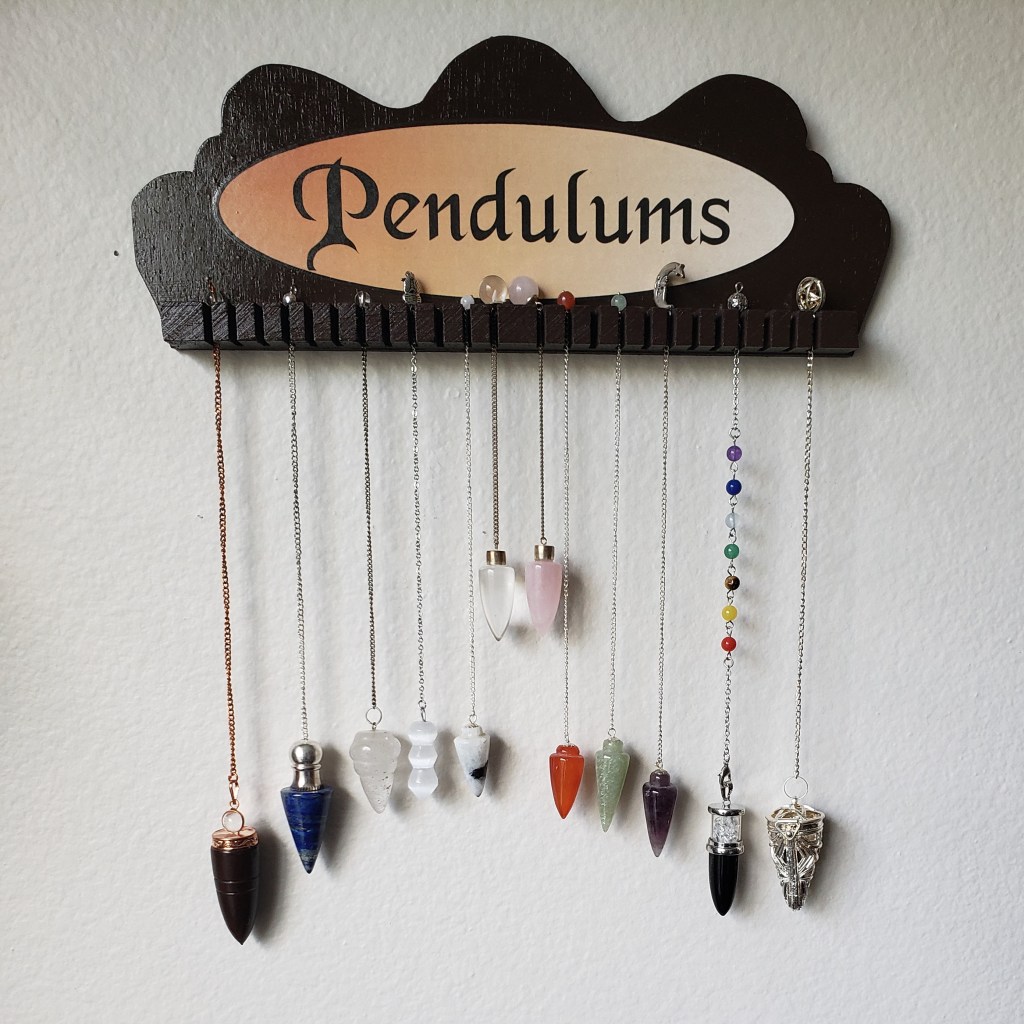
Some recommend keeping your tool wrapped after use in white linen or black/dark blue silk and storing safely away from the sun, as sunlight can neutralize the moon charge. Personally, I keep mine displayed on a pendulum rack! As long as you take care of your pendulum and charge it regularly, you don’t need to keep it hidden away.
Method:
To begin, you will use the same method mentioned in the previous blog post:
Darken the room and light with only a single, small light source such as a candle. Make sure the candle is located in a place that won’t distract you. The background should be basic, with nothing to distract you from your scrying tool. It is common to burn incense. Quiet, simple music can be played in the background if you so desire.
Cast your circle, say a protective prayer, invoke your deities, and begin scrying. Put the elbow of your scrying hand on the table. Hold the end of the thread between the fingers of your scrying hand. Ask your questions and observe the answers, using the interpretation of your choice. Once you are finished scrying, close your circle, thank your deities, and say a closing prayer. Extinguish your candle and incense and return your scrying materials to storage.
One of the great things about this method is that it can be done on the go! You don’t need any fancy tools to carry around with you, even a pendant can be used. If you’re in a place or a situation where you can’t follow all the above steps, just say a protective prayer before scrying with your pendulum and you’ll be good to go.
Next week we’ll talk about another method of scrying – ouija board scrying! So check back soon!
Sources:
Buckland, Raymond. Buckland’s Complete Book of Witchcraft. St. Paul, Minn., U.S.A: Llewellyn Publications, 1986. Print.
Buckland, Raymond. Wicca for One. New York, NY, U.S.A: Kensington Publishing Corp., 2018. Pring
Cunningham, Scott. Divination for Beginners. Woodbury, Minn., U.S.A: Llewellyn Publications, 2008. Print.
Robbins, Shawn, and Leanna Greenaway. Wiccapedia. New York, NY, U.S.A: Sterling Ethos, 2014. Print.
Tyson, Donald. Scrying for Beginners. Woodbury, Minn., U.S.A: Llewellyn Publications, 1997. Print.
 Northern Lights Wicca
I’ve been a Wiccan Preast for over 50 years and your Article was very helpful.
Bless it be!
LikeLike
For a majority of nature loving people it is sad that so many people want to condemn people who celebrate the Earth.
LikeLike